Clashes Erupt at Cop30 as Indigenous Protesters Storm Conference Centre in Belém — The Guardian
 thegreencall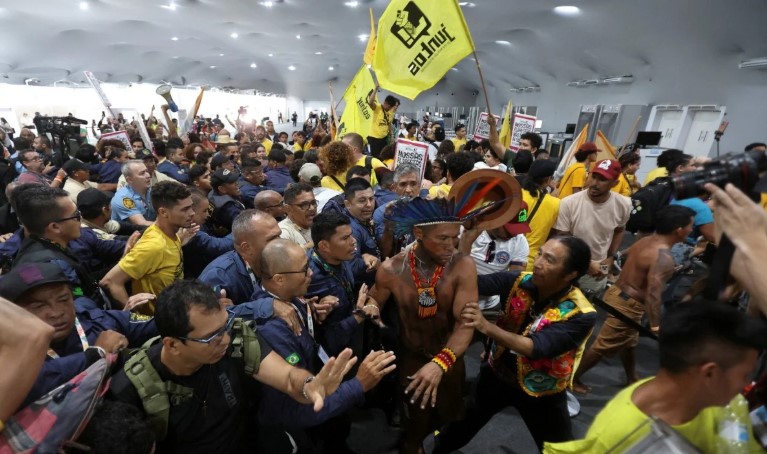
Source: The Guardian, International Edition
Date: Tuesday Night, Belém, Brazil
Byline: The Guardian Environment Correspondent
Tensions flared at the COP30 climate summit in Belém late Tuesday night when Indigenous and non-Indigenous demonstrators forced their way into the main conference venue, demanding greater inclusion and action to protect the Amazon rainforest.
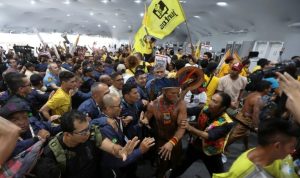
According to The Guardian, several dozen protesters — many wearing brightly coloured feathered headdresses — ran through the entrance of the venue, pushing a door off its hinges and charging through metal detectors into the Blue Zone, a restricted area designated for official climate negotiations.
UN security personnel quickly intervened, resulting in scuffles, shouting, and shoving between protesters and guards. At least one demonstrator carried a banner reading “Our forests are not for sale,” while others wore shirts emblazoned with “Juntos” (Together).
Witnesses reported that the demonstrators waved flags and chanted slogans until they were forcibly removed. A UN climate spokesperson confirmed that two security guards sustained minor injuries and that there was “minor damage to the venue.” Fire brigade officers later cordoned off the entrance to prevent further breaches.
While the identities of the organisers remain unclear, some observers expressed a degree of sympathy. “At last, something has happened here,” said Juan Carlos Monterrey-Gómez, a climate negotiator from Panama, commenting on the lack of urgency at previous sessions.
Agustin Ocaña, from the Global Youth Coalition, told the Associated Press that the demonstrators had chanted “They cannot decide for us without us” — a reference to Indigenous communities’ longstanding frustration over being excluded from decision-making processes.
Ocaña described chaotic scenes near the secure entrance, where protesters and guards allegedly struck each other with small plastic bins used for security checks. One guard reportedly suffered a head wound.
He added that many Indigenous activists were angered by the vast funds allocated to building what they called “a whole new city” for Cop30, instead of investing in education, healthcare, and forest protection. “They’re desperate, trying to protect their land, the [Amazon] river,” he said.
In an official statement, the United Nations said its Brazilian and UN security teams took “protective actions to secure the venue, following all established protocols.” The UN confirmed that “the venue is fully secured and Cop negotiations continue.”
Unlike the previous three climate summits — held in nations with more restrictive political environments — Brazil’s government has actively encouraged public participation, civil society engagement, and peaceful demonstrations.
Throughout Cop30, Indigenous organisations and environmental NGOs have maintained a strong presence both inside and outside the venue, counterbalancing the corporate lobbyists who have dominated recent conferences.
A series of public events is scheduled in the coming days, including a “People’s Summit” on Thursday and Friday, and a global youth rally on Friday. The largest march is expected on Saturday.
So far, most protests have remained peaceful — including rallies by feminist groups, pro-Palestinian advocates, and health-and-environment activists earlier in the week.
However, security officials anticipate increased demonstrations as an estimated 100-vessel flotilla carrying Amazonian leaders, including Raoni Metuktire and Davi Kopenawa Yanomami, arrives in Belém tomorrow.
About The Author